Tuesday, July 23, 2013

Holiday reading: TCP Congestion control

Have you ever want to know how TCP shares the bandwith between different connections. TCP has to choose which connections need which amount of bandwith and how to handle the latency requirements of different types of connections. So that your voip call will not become unreliable when you start a large download.  There are different algorithms for this problem for example compound in Windows and cubic in Linux. But which of this algorithms is better for a given scenario in a heavy used network.

Here are my holiday readings regarding this topic:

Comparison of different congestion algorithms

Compound Congestion algorithm in detail

Remy a new high performance TCP algorithm

Saturday, July 20, 2013

First steps with the Java UCI API to access a starface PBX

In my last Starface related blog post i have shown how to configure the UCI API of the starface PBX in eclipse. Today i want to show you how to use the API to access data and functions in the starface PBX.

The first step to access data on the starface PBX is to create an UciProxy Object. The proxy object manages the connection to the PBX in the background. The proxy object is really handy, because it reestablish the connection automatically in the background if the connection to the PBX has been lost. The proxy object can use different transport methods to access the PBX. Here is an example for a connection without callback over HTTP.


   //Create a Ucpransportfactory to access the starface PBX over the HTTP protocol.
   UcpTransportFactory ucpTransportFactory = new HttpUcpTransportFactory("YOURSTARFACE", 80, false);
   //Create a UciProxyFactory with the above created Transportfactory.
   UciProxyFactory uciProxyFactory = UciProxyFactory.createWithTransportFactory(ucpTransportFactory);
   //Create a proxy with the given credentials
   uciProxy = uciProxyFactory.createUciProxy("0001", "PASSWORD");
   //Establish the connection to the starface PBX
   uciProxy.connect();

Please replace "YOURSTARFACE", "0001" and "PASSWORD" with the host name, your user id and your password.

The next step is to create a so called  "Request Object". Every access able function in the starface PBX is handled by this objects. Here is a list of all Request Objects and their use:

Request Object Use
UciCallListRequests Get and manipulate the call list
UciCallRequests start and end telephone calls or get the state of your telephone
UciFaxListRequests Get and manipulate the list of your faxes or get the transmission report of a fax.
UciFaxRequests Send new Faxes
UciFunctionKeyRequests Get manipulate and press the function keys of your telephone
UciGroupRequests Get and set Group settings
UciPhoneRequests Manage your phones or set your primary phone
UciRedirectRequests Change the redirect settings of your telephones
UciUserStateRequests Get and set your avatar and manipulate your presence awareness status.
UciVoicemailListRequests Get and manipulate the list of your voice mails

And here is the code to access your call list and write all inbound calls to the console.

   // Get a CallListRequest Object to access the calllist
   UciCallListRequests requests = uciProxy.getRequests(UciCallListRequests.class);
   // Get the inbound calllist for the lastday with no group calls,
   // ordered by startTime Ascending. If there are more then 1000
   // entries only the the first 1000 will be retrieved.
   CallList callList = requests.getCallList(new Date(), new Date(new Date().getTime() - 86400000),
     CallListEntryDirection.INBOUND, null, GroupRestriction.NON_GROUP,
     CallListEntryProperties.startTime, OrderDirection.ASCENDING, 0, 1000);
   // Create date and timeformater
   DateFormat df = SimpleDateFormat.getDateInstance();
   DateFormat tf = SimpleDateFormat.getTimeInstance();
   // Iterate through the callist entries and print every entry to
   // standard out.
   for (CallListEntry entry : callList.getEntries()) {
    System.out.println(entry.getId() + "/" + entry.getCalledNumber() + "/" + entry.getCallerNumber() + "/"
      + df.format(entry.getStartTime()) + " " + tf.format(entry.getStartTime()) + "/"
      + entry.getDuration());
   }
So you can see that the UCI API is very easy to use and with only a few lines of code you can access many information's in your PBX which are normally only available in the web interface. In the next post in the starface series i will show you how to get notifications about events occurring in the PBX. So stay tuned.

Saturday, July 6, 2013

Migrate a Twinax Console to a Lan Console on IBM i.

I do not know if i was the last on earth who was still using a Twinax Console to operate an i/5, but today i have migrated  succesfully our twinax console to a LAN Console. I had to do the following steps for the migration:

Locate the LAN Console Port on your system. For our Modell 520 it is the T5 port. If you are unsure check the Power Systems info center for informations how to locate the Lan Console port. Check with wrkhdwrsc *cmn  and wrkcfgsts *lin that there is no active line description configured for this ethernet port. The Lan Console port cannot be shared with other Ethernet lines on your system.

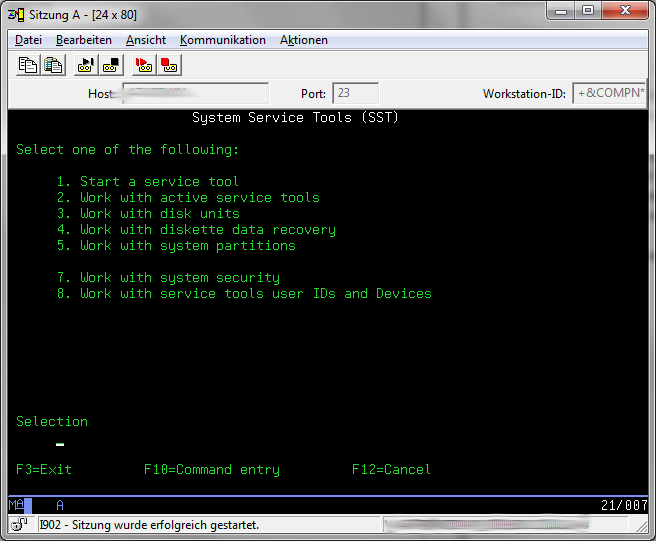
Then sign in to the System Service Tools with strsst


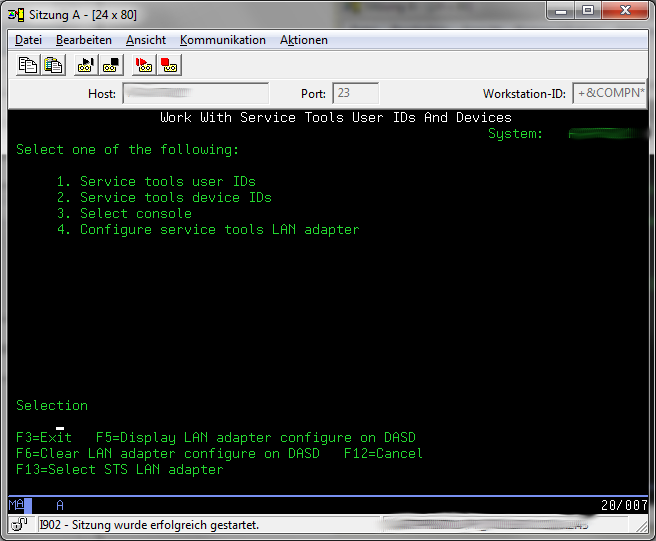
Choose Option 8 "work with service tools user IDs and Devices"


Choose option 4 "Configure service tools LAN adapter"


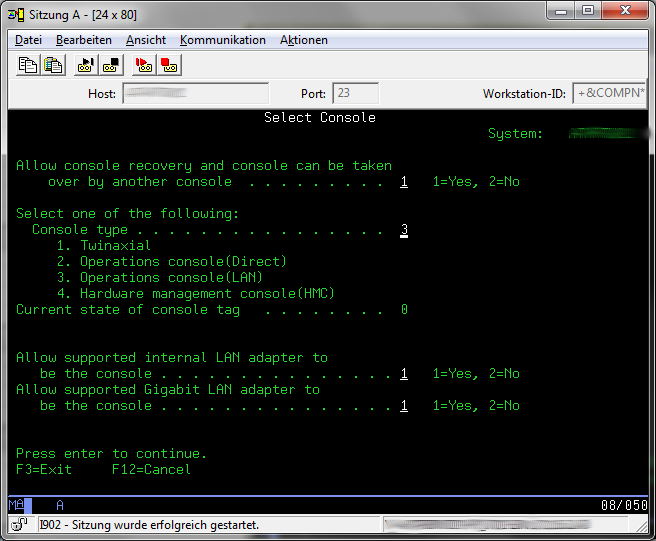
Change all values on the "select console" so that the match the screenshot and the press "Enter" to continue.

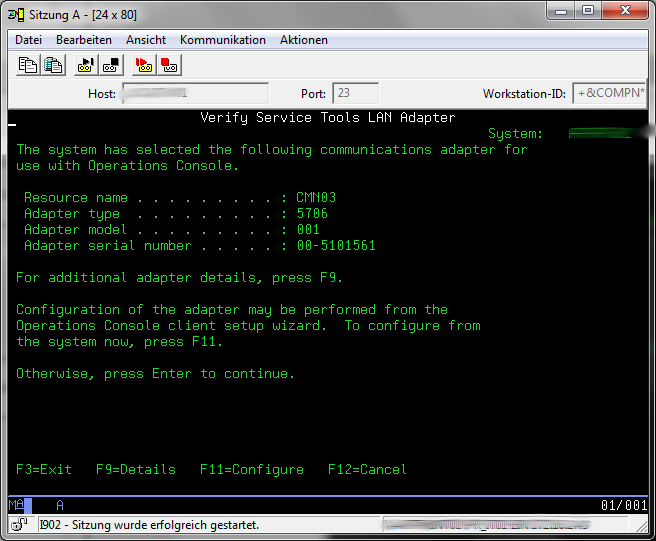
Press F11 to go to configure your new service LAN Adapter.


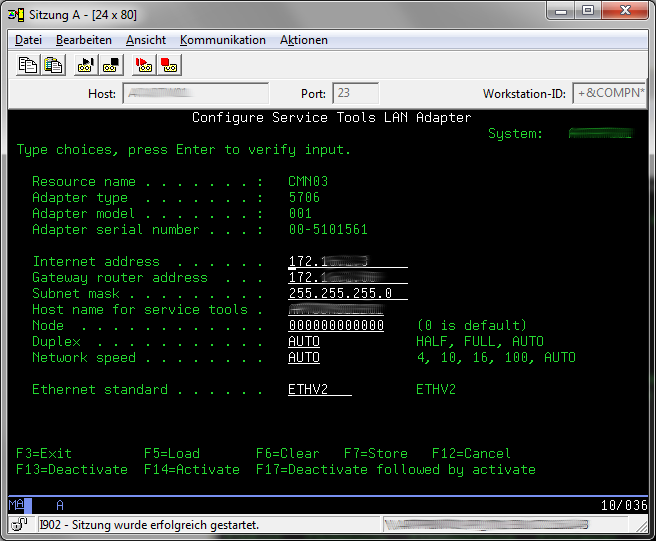
Fill in a static IP Address for the LAN Adapter and the default gateway and subnet mask matching your LAN configuration. As an Hostname for service tools you can use every symbolic name you want for example "SYSCONSOLE1". This IP address habe to be unused and must not match any IP Address of other servers in your network. Then press "F7" to store your configuration and go back with multiple "F3 presses to the start screen of the SST.

Normally you have to make an IPL to activate your new console configuration. But if you are not able to IPL your machine you can try the following steps to activate the LAN Console without an IPL.

Start SST with STRSST if you are not already in the SST Screen.


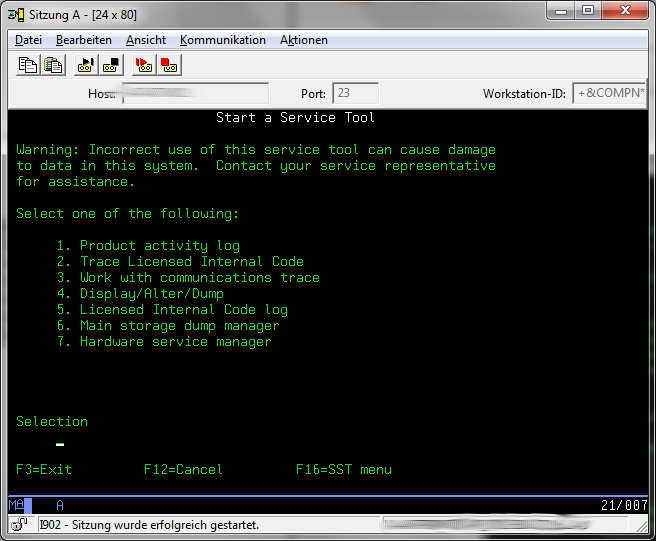
Select Option 1 "Start a service tool"


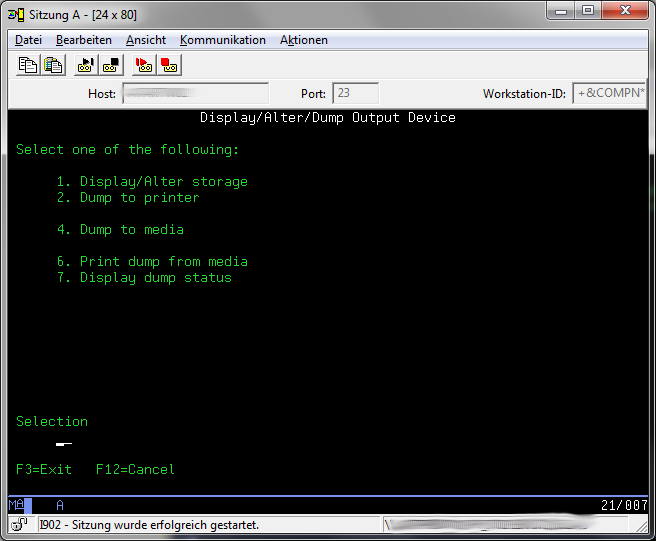
Select Option 4 "Display/Alter/Dump"


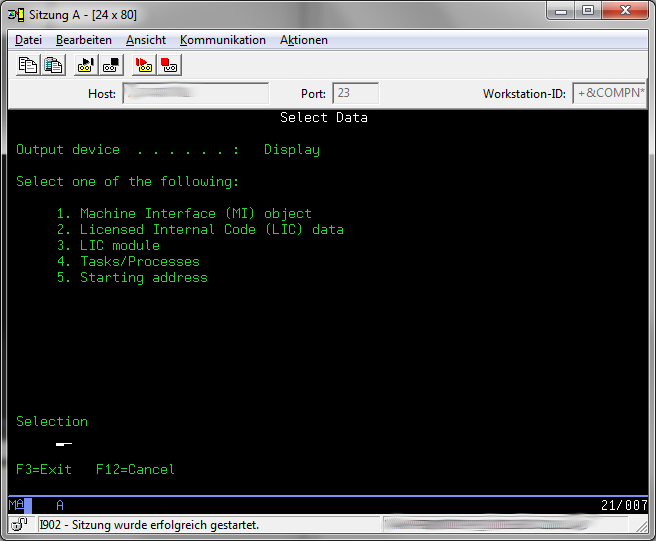
Select Option 1 "Display/Alter storage"


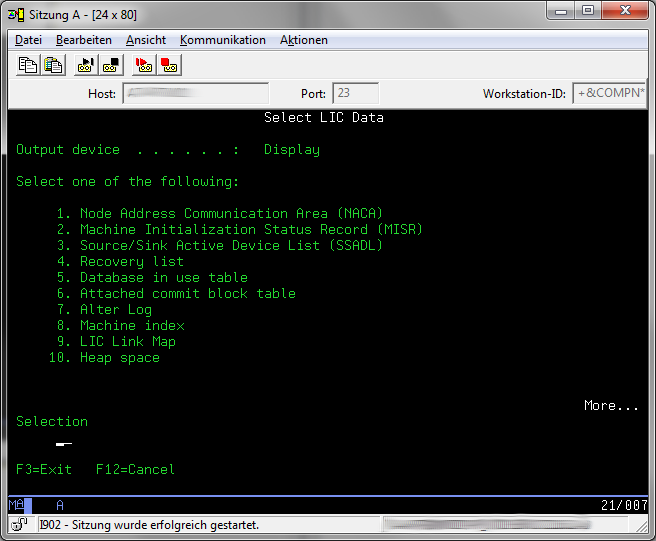
 Select Option 2 "Licensed Internal Code (LIC) data"


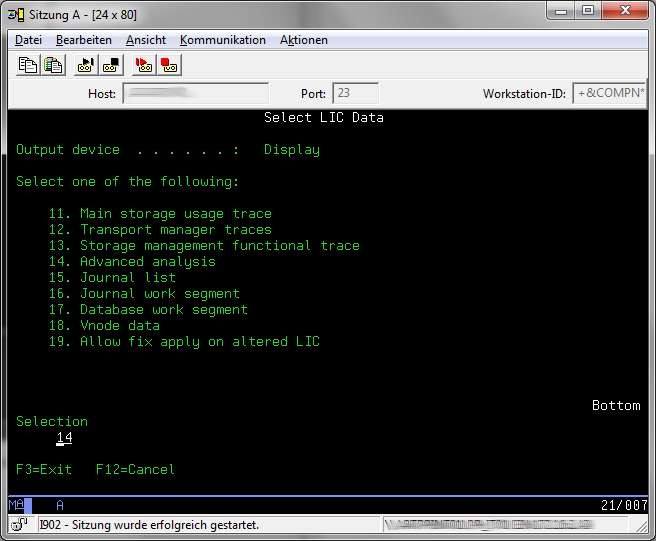
 Press Page Down to go to the second menu of "Select Lic Data".


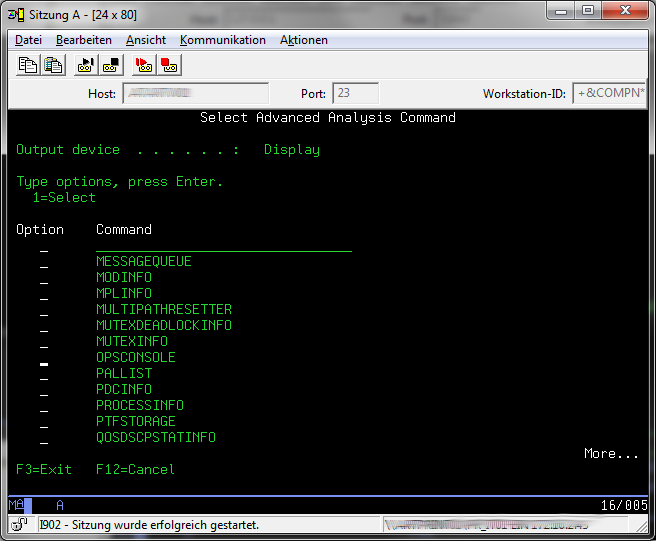
Select Otion 14 "Advanced Analysis" and page down in the List of the Macros till you see the "OPCONSOLE" macro.


Select the "OPCONSOLE" macro with "1"


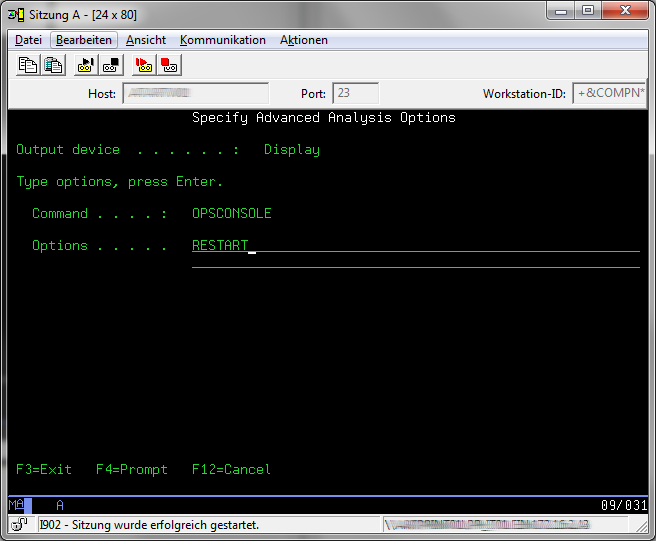
Fill in "RESTART" as the option and press enter to run the macro. After that you can leave the SST.

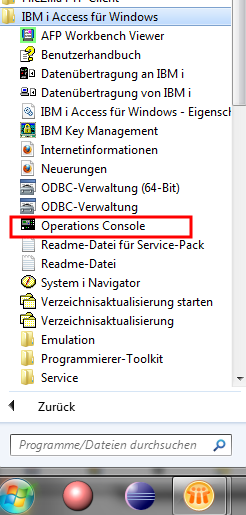
Now you can try your new LAN console on your local workstation. Start the "Operations Console" from the i Access start menu.
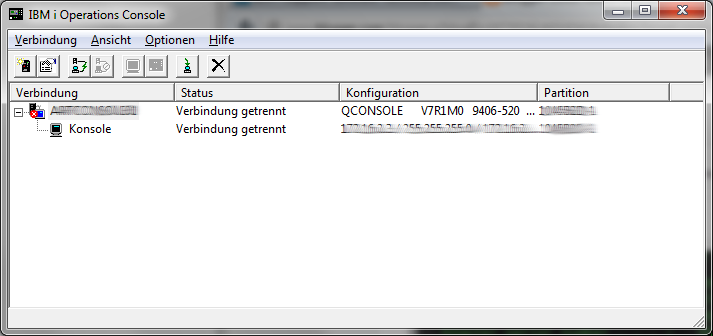
When everything is configured correctly the operations console will discover the console port automatically and you can connect to the console of your system.

After the connection has been established you have to sign in with a SST user. Be aware that the username and password is case sensitive.

Friday, June 28, 2013

Rational Developer for IBM i 9 is available

A new version of the Rational Developer for i is available. RDI in the version 9 is the new name for a tool which was also known as WDSC, RDP and many more other names. RDI is an eclipse based development tool for software development on Power systems running i aka known as AS/400, iseries, system i. With RDI 9 some long time awaited improvements have been made by Rational. The eclipse base has been upgraded from 3.6.x to the 4.2.2 codebase. So you have a much improved JDT (Java development tool) and you are able to install all the cool plugins which comes with eclipse 4.2.2 in your Rational Developer. The special plugins like the System i enabled RSE (Remote System Explorer) LPEX (Editor for RPG and Cobol) have got enhancements too. The Outline in RPG should show the informations more detailed and Rational promises that many functions will give a better performance. This will be much appreciated, because performance is one of the weak points of the old RDI versions.

RDI comes in three versions:

Rational Developer for i RPG and Cobol Tools

This is the tool for the classic i Developer who wants to build green screen applications with RPG and Cobol. Also included is a graphical Version of SDA and plugins to access the db2 on i. There is no support for Web development in this version from Rational, although you can add open source plugins from Eclipse to fill the gap.

Rational Developer for i RPG and Colbol + Modernization Tools

This version has all of the Basis version with many additional plugins to build Web Applications on the Websphere software stack from IBM. Many of this plugins are very complex and need highly trained developer on this tools to be productive. The are very good for big multi tier systems, but maybe to complicated for small projects For smaller projects the base version with added open source plugins from eclipse are an interesting alternative.

Also included in this version is the new IBM Worklight Studio 6.0 to build mobile applications. The strange thing is that applications which are built with IBM Worklight Studio 6.0 can not be deployed to the i. You have to deploy them to a Windows or Unix Worklight server which can then access the db/2 on the i.
  
Rational Developer for i RPG and COBOL + Modernization Tools, EGL Edition v9.0

This is the replacement for IBM Rational Developer for i for SOA Construction. I have no informations about this version, but IBM has promised for such a long time that EGL has a bright future with no visible results, that i can not believe in this future anymore.

*Updated*You can find additional informations to the new versions on http://www-03.ibm.com/software/products/us/en/dev-ibm-i. or in the announcement. Das Informationcenter wurde ebenfalls bereits für die Version 9 aktualisert.

Unfortunatly up to now there is no Tial version of 9 available, but i have already contacted a sales representative of IBM when and where a Trial for this version will be available. *Updated* Eric Simpson has blogged about RDI and at the end of his post is a  tutorial  how to install the trial with the installation manager manually.


Thursday, June 27, 2013

Other useful Display filters in Wireshark


In one of my last posts i have talked about how to trace DHCP communication in Wireshark. Today i want to show some other very usefull Displayfilters in Wireshark.

ip.addr==xxx.xxx.xxx.xxx

Display all IP traffic coming from or going to the specified IP Address.

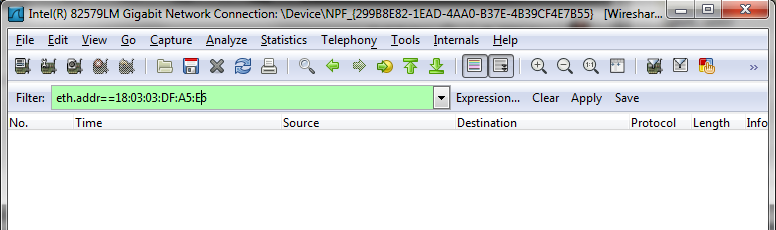
eth.addr==xx:xx:xx:xx:xx:xx

Display all Network traffice coming from or going to the specified Mac Address.

!arp

Hide Address Resolution Protocol packets to prevent the flood of them in your communication trace.
 
http.set_cookie


See all packets in the communication trace which sets cookies.

http.cookie

See all packets in the communication trace which transport cookies to remote server.


You can replace the "==" with contains to search for a part of an address. For example if you want the whole traffice from and to 10.0.10.x then use ip.addr contains 10.0.10.

It is possible to combine filters with the logic operators "and, or, xor, not" For xample "ip.addr==10.0.0.10 and not eth.addr==45:20:24:ff:5a:18" checks if there are packets with ip address 10.0.0.10 which do not come from the correct network adapter.

You can specify the protocol like "smb","http" or "smtp"... of the traffic you want to analyze and all other protocols will be hidden in your trace.

A very good cheat sheet is available from packetlife.net


Wednesday, June 26, 2013

Eclipse 4.3 Kepler has been released.

Today the Eclipse Foundation has released Eclipse 4.3 (Kepler). Eclipse 4.3 is really a step in the right direction after the little bit disappointing 4.2 Version. Especially the performance of many functions like the switch to other editor parts has improved. Many other projects like WTP, RAP, BIRT has although seen great new features. So i really recommend, that every User of Eclipse 4.2 should upgrade his installation to 4.3. Users of the older 3.x code stream should wait till the first Service Release of 4.3 which i expect in September.

You can find all new features and bugfixes with screenshots in the "What's new" chapters of the online help of eclipse.


Tuesday, June 25, 2013

Download and configure the Starface UCI Java API in Eclipse

The first step to build a first class CTI plugin is to get a test environment where you can try out functions of the new java api without the complexity of the whole Notes client plugin system.

First of all, download the UCI Java API from the starface website and expand it to a folder on your harddisk. Unfortunatly the log4j.jar is missing in the UCI Java API download. So you have to download the log4j.jar from http://www.apache.org/dyn/closer.cgi/logging/log4j/1.2.17/log4j-1.2.17.zip and copy the log4j.jar from this zip to the "starface-uci-proxy-java-2.2.0\lib" folder in the UCI Java API folder.

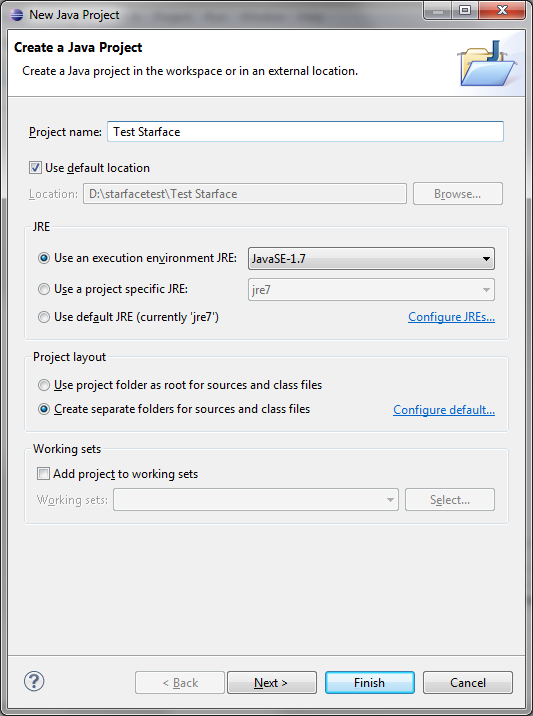
Create a new Java Project for your Tests in your Eclipse IDE.


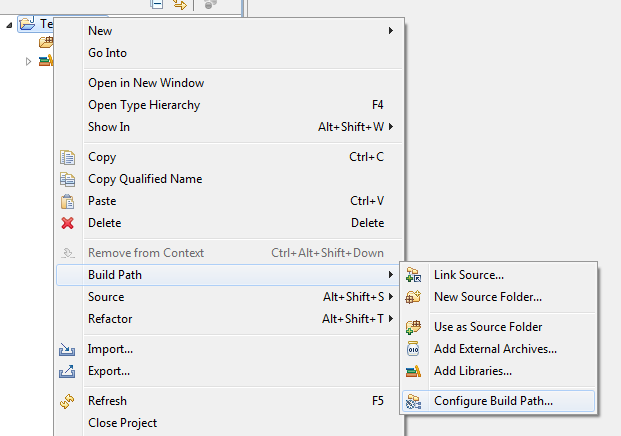
Right click your new Java project and select "Build path->Configure Build Path..."


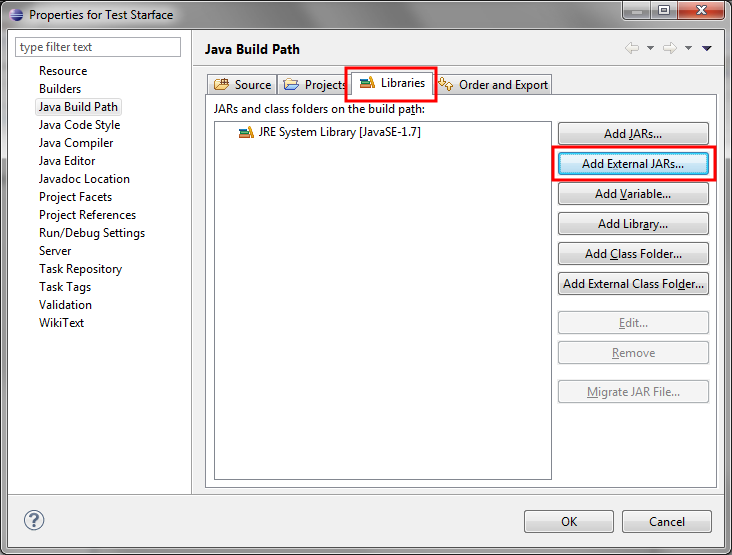
 In the Build Path Configuration select the "Libraries" Tab and click the "Add External JARs..." Pushbutton.

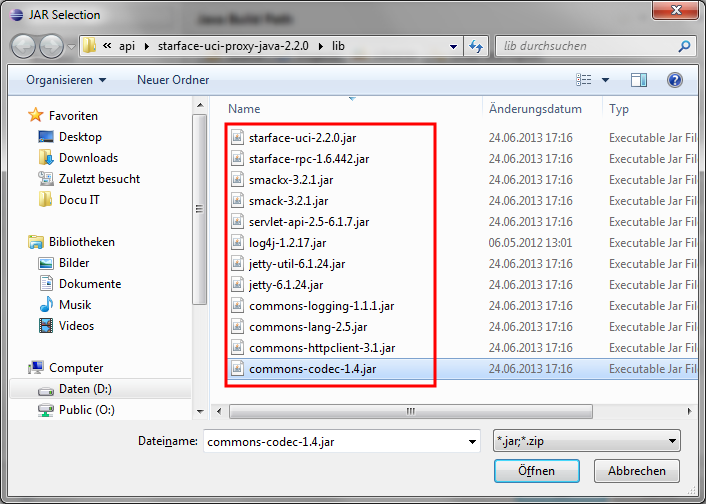
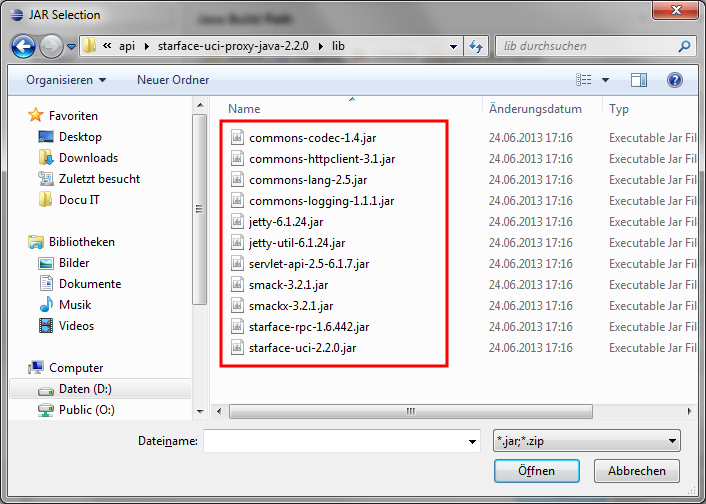
In the File selection dialog go to the directory where you have expanded the UCI Java API in Step 1 and add all jars in the "starface-uci-proxy-java-2.2.0\lib" folder to your build configuration.


Repeat the same steps to add the "starface-uci-proxy-2.2.0.jar" in the "starface-uci-proxy-java-2.2.0" folder to your build path configuration.

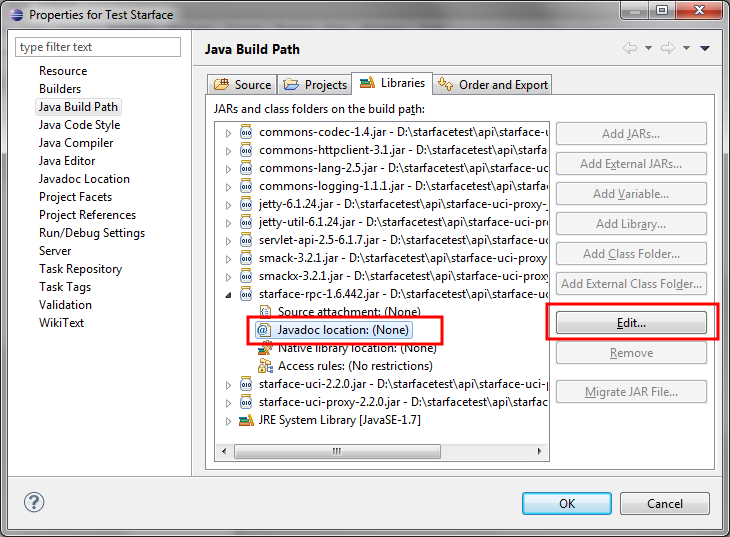
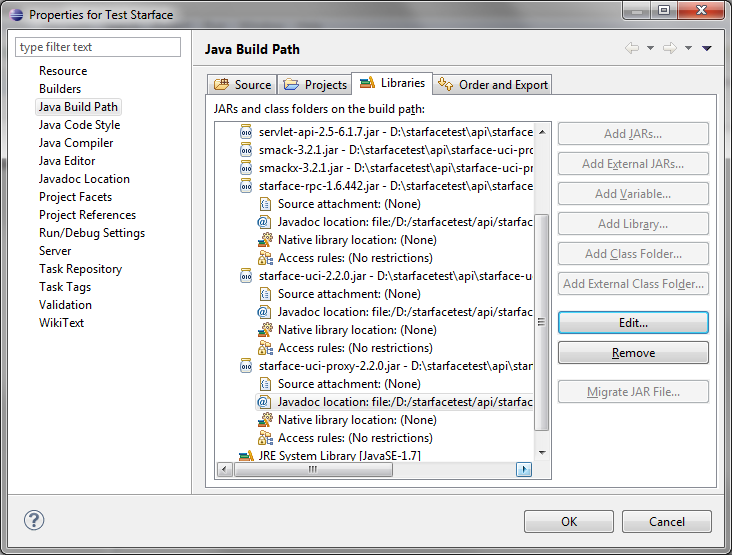
As an optional but very recommended step you can add the javadoc of the API to your build configuration. To do so expand the "starface-rpc.*.jar", click the Javadoc location line and select Edit.


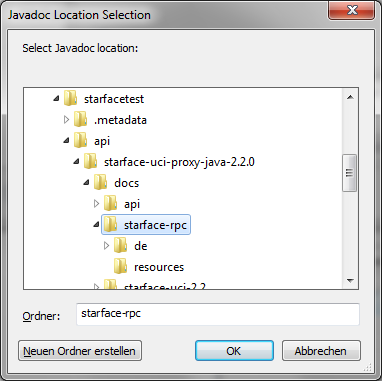
In the following Dialog select "Browse" and browse to the location of the "starface-uci-proxy-java-2.2.0\docs\starface-rpc" folder.

Repeat the steps to add the Java doc for starface-uci and starface-uci-proxy too.

Now your "Build path configuration" should look like this:


To test if everything has been configured correctly create a new Java class in your new Java project and paste the following code to the main function.

 public static void main(String[] args) {
  UciProxy proxy = null;
  try {
   UcpTransportFactory ucpTransportFactory = new HttpUcpTransportFactory(
     Inet4Address.getLocalHost().getHostAddress(), 8181,
     "starfacehost", 80, false, null, null);
   final UciProxyFactory uciProxyFactory = UciProxyFactory
     .createWithTransportFactory(ucpTransportFactory);
   UciProxy uciProxy = uciProxyFactory.createUciProxy("userID",
     "password");
   uciProxy.connect();
   proxy = uciProxy;

  } catch (UnknownHostException e) {
   e.printStackTrace();
  } catch (UcpConnectionFailedException e) {
   e.printStackTrace();
  } finally {
   if (proxy != null)
    proxy.disconnect();
  }
 }
You have to replace "starfacehost" "userID" and "password" with the correct values of your environment. When you run the programm you should see the following status message in the console view.

08:40:06,139 DEBUG openTransportAndAttach: Connecting to UCP server...
08:40:06,172 DEBUG Sending RPC request: ucp.v22.requests.connection.login() to http://starfacehost:80/xml-rpc?de.vertico.starface.auth=edb03a2ba7cca2c7b8100dfdedc83ba0&de.vertico.starface.user=userID&de.vertico.starface.callback.type=http&de.vertico.starface.callback.host=172.16.2.85&de.vertico.starface.callback.port=8181&de.vertico.starface.callback.path=/
08:40:06,234 DEBUG Incoming RPC return value: true from http://starfacehost:80/xml-rpc?de.vertico.starface.auth=edb03a2ba7cca2c7b8100dfdedc83ba0&de.vertico.starface.user=userID&de.vertico.starface.callback.type=http&de.vertico.starface.callback.host=172.16.2.85&de.vertico.starface.callback.port=8181&de.vertico.starface.callback.path=/
08:40:06,234 DEBUG Sending RPC request: ucp.v22.requests.service.subscribeEvents("ucp.v22.events.connection") to http://starfacehost:80/xml-rpc?de.vertico.starface.auth=edb03a2ba7cca2c7b8100dfdedc83ba0&de.vertico.starface.user=userID&de.vertico.starface.callback.type=http&de.vertico.starface.callback.host=172.16.2.85&de.vertico.starface.callback.port=8181&de.vertico.starface.callback.path=/
08:40:06,234 DEBUG Incoming RPC return value: true from http://starfacehost:80/xml-rpc?de.vertico.starface.auth=edb03a2ba7cca2c7b8100dfdedc83ba0&de.vertico.starface.user=userID&de.vertico.starface.callback.type=http&de.vertico.starface.callback.host=172.16.2.85&de.vertico.starface.callback.port=8181&de.vertico.starface.callback.path=/
08:40:06,234 INFO  shutdown: RPC server is currently not running.
2013-06-25 08:40:06.250:INFO::Logging to STDERR via org.mortbay.log.StdErrLog
2013-06-25 08:40:06.282:INFO::jetty-6.1.24
2013-06-25 08:40:06.297:INFO::Started SocketConnector@0.0.0.0:8181
08:40:06,297 DEBUG Registered  RpcMethod [name=ucp.v22.events.connection.reset, method=public abstract void de.starface.integration.uci.java.v22.ucp.messages.events.UcpConnectionEvents.reset(), requiredAuthType=null, object=RpcObject [rpcInterface=interface de.starface.integration.uci.java.v22.ucp.messages.events.UcpConnectionEvents, namePrefix=null, requiredAuthType=class de.starface.integration.uci.v22.client.transport.http.LoginUrlAuthToken, name=ucp.v22.events.connection]]
08:40:06,297 DEBUG Successfully registered RpcObject [rpcInterface=interface de.starface.integration.uci.java.v22.ucp.messages.events.UcpConnectionEvents, namePrefix=null, requiredAuthType=class de.starface.integration.uci.v22.client.transport.http.LoginUrlAuthToken, name=ucp.v22.events.connection]
08:40:06,297 DEBUG openTransportAndAttach: Connecting to UCP server...
08:40:06,297 INFO  onConnectionEstablished: Connection to UCP server successfully initialized.
08:40:06,297 DEBUG startReconnectTimer: Activating reconnect timer.
08:40:06,297 DEBUG resubscribeAllEvents: Resubscribing all UCP events...
08:40:06,297 DEBUG resubscribeAllEvents: Finished resubscribing events.
08:40:06,297 INFO  onConnectionEstablished: Connection to UCP server successfully initialized.
08:40:06,297 DEBUG stopReconnectTimer: Deactivating reconnect timer.
08:40:06,297 DEBUG closeTransportAndDetach: Disconnecting from UCP server...
08:40:06,297 DEBUG Sending RPC request: ucp.v22.requests.connection.logout() to http://starfacehost:80/xml-rpc?de.vertico.starface.auth=edb03a2ba7cca2c7b8100dfdedc83ba0&de.vertico.starface.user=userID&de.vertico.starface.callback.type=http&de.vertico.starface.callback.host=172.16.2.85&de.vertico.starface.callback.port=8181&de.vertico.starface.callback.path=/
08:40:06,297 DEBUG Incoming RPC return value: true from http://starfacehost:80/xml-rpc?de.vertico.starface.auth=edb03a2ba7cca2c7b8100dfdedc83ba0&de.vertico.starface.user=userID&de.vertico.starface.callback.type=http&de.vertico.starface.callback.host=172.16.2.85&de.vertico.starface.callback.port=8181&de.vertico.starface.callback.path=/
08:40:06,297 DEBUG shutdown: Shutting down RPC server...
2013-06-25 08:40:06.297:INFO::Stopped SocketConnector@0.0.0.0:8181
08:40:06,407 DEBUG shutdown: RPC server shut down.
08:40:06,407 INFO  closeTransportAndDetach: Successfully disconected from UCP server.
08:40:06,407 INFO  shutdown: RPC server is currently not running.


Trace DHCP traffic with wireshark

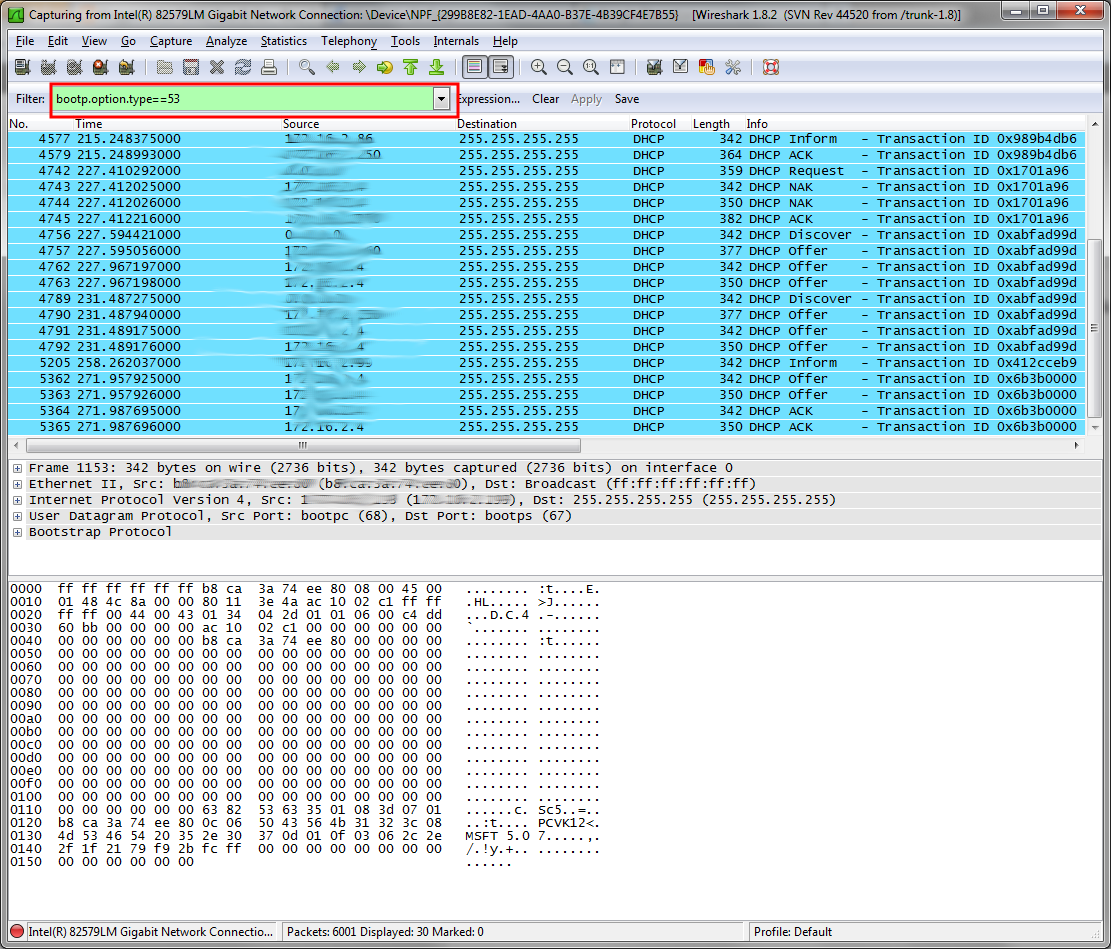
The best tool to analyze weird problems in DHCP Systems is the network analysator Wireshark. But the network traces of wireshark can be very big and confusing. So you have to use filters to select only the traffic you really need to solve your problem. To see only DHCP traffic on your network interface you have to apply "bootp.option.type==53" in Wireshark.


ad